Thursday, July 9, 2015

Barwick's Onward Store, Onward, Mississippi

This community has got a lot of heart
For this is where the teddy bear got its start

Onward store is more than a convenience stop on a lonely stretch of U.S. 61.
Practically all Americans are aware that Theodore Roosevelt, 26th President of the United States, was an outdoorsman and a naturalist. After all he was responsible for the founding of 52 National Wildlife Refuges during his Presidency, protecting for future generations 230 million acres of American wilderness. Immediately after leaving office in 1909 he went on an African safari and collected thousands of specimens for the Smithsonian National Museum. Roosevelti, the Latin translation, appears in the scientific names of many species of plants, fish, reptiles and mammals native to several different continents.

Asked to remember a particular Roosevelt big game hunt, though, and the vast majority of the population can only recall one, an otherwise unnoteworthy expedition, except for the fact that the President didn't shoot anything.

In the Fall of 1902, during his second year in the White House, T. R. received an invitation from Govenor Andrew Longino of Mississippi to go bear hunting. Eager to do some polliticking as well (Longino was up for re-election), he arrived in Mississippi a month later.

In the interim a locally famous bear hunter and guide, Holt Collier, had been enlisted, sworn to secrecy, and sent out to find a suitable bear camp for the hunt. Collier was an interesting enough fellow in his own right. Though born into slavery, he had served as a Confederate scout under Nathan Bedford Forrest during the Civil War. His exceptional skills as a horseman and marksman were well known. He would later kill over 2000 black bears, hunt grizzlies in Alaska, and tend race horses in Texas.

Collier was arrested and exonerated more than once for murder. He outgunned an outlaw in a close-quarters gunfight in one case, and it was never quite proven he was the person who intervened in a fight between a young Union soldier and Holt's beloved old master Colonel Howell Hinds. The soldier was killed, and likely Collier would have hanged except for the intervention of some of the landed gentry among Colonel Hinds' friends.

He also hunted again with Roosevelt in 1907 in Northeastern Louisiana. The President killed a bear this time, describing the exploits in the January, 1908 edition of Scribner's Magazine, which featured an artcle "In the Louisiana Canebrakes" by Theodore Roosevelt, illustrated with the four period photos seen on this page. Despite all this publicity, the event is largely forgotten.

The President's 1902 bear hunt started on the morning of November 14th, attended by not a few local and national dignitaries. The future governor of Louisiana, John Parker, Huger Foote, whose grandson Shelby would become a noted Civil War author, John McIlhenny, heir to the Tabasco sauce fortune, and President of the Illinois Central Railroad, Stuyvesant Fish formed part of the hunting party. A local trapper named John Bobo brought a seasoned pack of 50 bear dogs, but Holt's pack of hounds picked up the first scent. His dogs ran their prey into a slough and began to suffer a terrible mauling from the bear, a 235 pound male. Holt is reported to have knocked the animal unconscious to save his beloved bear dogs and then tied the bear by the neck to a tree.

He later recalled President Roosevelt had insisted that he "must see a live bear the first day." Collier claimed to have told him he would tie one up and bring it to him if he had to, but "he would see that bear". Since the bear wasn't fit for travel, Holt did the next best thing. He blew his hunting horn for the rest of the party to join him.

When Roosevelt and the others arrived, the President was offered the opportunity to claim his trophy, but he refused to shoot the tethered, wounded animal. Roosevelt was the product of an aristcratic hunting tradition. Under this "true sportsmen's code", the taking of young animals or any animal which did not have a sporting chance is forbidden. Collier claims to have led John Parker into the water to stab the bear and put it out of its misery. Though not uneventful, the hunt was unsuccessful from Roosevelt's point of view, and he saw no reason to document it in writing as he did so many others.
The press went wild over the story of President Theodore Roosevelt, Holt Collier and the bear, and it soon traveled across the country in news stories and cartoons. Roosevelt's refusal to kill this defenseless animal was seen as far more newsworthy than if he had killed a state record! It was widely reported, prompting Washington Post cartoonist Clifford Berryman to produce a cartoon entitled "Drawing the Line in Mississippi".

For more information, visit: theonwardstore.com


Louisville Slugger Museum & Factory, Louisville, Kentucky

Come see where world famous baseball bats are made
You might say that this is why baseball is played

This is the story behind the world-famous Louisville Slugger baseball bat, and the family-owned company that has created it since 1884.
J. Frederick Hillerich emigrated with his family from Baden-Baden, Germany to Baltimore, Maryland in 1842. The Hillerichs moved to Louisville in 1856, where J. Fred started a woodworking shop. By 1864 "J.F. Hillerich, Job Turning" was in business and filled orders for everything from balusters to bedposts. Hillerich’s eldest son, John Andrew "Bud" Hillerich, was born in Louisville in 1866.
The business thrived and by 1875 the little woodworking shop employed about 20 people. In 1880, Bud Hillerich, who was an amateur baseball player, became an apprentice in his father's shop. Young Bud made his own baseball bats along with bats for several of his teammates.
There is debate over the origins of the company's first bat for a professional player, but Bud most certainly played a key role in getting his father's business involved with what would become the company's signature item. 
According to company legend, the first pro bat was turned by Bud for Pete Browning in 1884. Browning was a star on Louisville's professional American Association team–the Eclipse. On a spring afternoon Bud, then seventeen years old, witnessed Browning break his favorite bat. Bud offered to make a bat for his hero and Browning accepted. According to the story, after the young wood shop apprentice lathed a quality stick from white ash Browning got three hits with it in the next game. Because of his tremendous hitting power, Browning was known as "The Louisville Slugger" years before the Hillerich family trademarked the name for their bats.
Despite Bud’s passion for the product, his father wanted nothing to do with making bats. His business was built on making roller skids, bed posts, tenpins, wooden bowling balls and a very popular, patented, swinging butter churn. However, Bud Hillerich continued to improve the manufacturing processes of the new bat business, inventing a centering device for a lathe and an automatic sander. Their baseball bat business grew. The bat was first known as the Falls City Slugger, (a reference to Louisville's location at the Falls of the Ohio River), but the brand name was changed to Louisville Slugger and registered as a trademark in 1894. Bud Hillerich became a partner with his father in 1897 and the name of the firm was changed to J.F. Hillerich and Son.
The success of the growing bat company was further enhanced in 1905 when Honus "The Flying Dutchman" Wagner, a superstar shortstop for the Pittsburgh Pirates, signed a contract as the first player ever to endorse a bat. His autograph was also the first to be used on a bat and the first time a professional athlete endorsed an athletic product.
In 1911, Frank Bradsby, a successful salesman for one of Hillerich's largest buyers, joined J.F. Hillerich and Son. He brought sales and marketing expertise and drive to the company. In 1916, he became a full partner, and the company name was changed, for the last time, to Hillerich & Bradsby Co. Seeking to diversify products, Bradsby propelled the firm into producing golf clubs, eventually creating the PowerBilt brand.
The success of the Louisville Slugger bat was due in part to the fact that amateur baseball players across the country could purchase the bat model of their favorite big-league player. In 1915, the Louisville Slugger first appeared in a youth-size model. In 1919, the company launched its first national advertising campaign and in just four years was producing one million bats a year. The success, however, was marred the next year by the death of J. Frederick Hillerich. His son, Bud, became the boss.
A disastrous flood along the Ohio River in 1937 did significant damage to one of the factories and some of the offices. Working almost nonstop for weeks to repair the factory, Frank Bradsby was worn down. His efforts during this ordeal are believed to have led to his death later that year.
Hillerich & Bradsby Co. served its country during World War II by producing M-1 carbine stocks, tank pins and billy clubs for the armed forces. It also continued to make baseball and softball bats for the troops. Bud Hillerich died in 1946 and his son Ward took over. But after only three years as president, Ward died in 1949. His brother, John A. Hillerich Jr., succeeded him.
In 1969, John Hillerich Jr. died and his son, John A. “Jack” Hillerich III, at 29 years old, was named company president.
In 1970, the company began producing aluminum bats. Louisville Slugger aluminum and composite bats, are available in adult baseball, youth baseball, and softball models. Today, the TPX and TPS brands are huge hits and are the top selling models in the business. The first line of Louisville Slugger baseball and softball gloves was introduced in 1975.  
In 1996, Hillerich & Bradsby Co. moved into new headquarters at 800 West Main Street. Professional baseball players continue to have their bats custom made at the wood bat manufacturing facility, not far from where the very first bats were made back in the 1800's.    
Louisville Slugger Museum & Factory, one of the city's most popular attractions, is also housed with the corporate headquarters. The location is well-marked by the World's Biggest Baseball Bat that casually leans against the side of the building. Guests are invited to learn about the Official Bat of Major League Baseball–Louisville Slugger. Today, over 3-million people have enjoyed the museum and factory tour experience at this location. 
John A. “Jack” Hillerich III retired as CEO and President in 2001 but remains as Chairman of the Board. His son, John A. Hillerich IV, succeeded him and currently serves as CEO and President. John is the great-grandson of Bud Hillerich, the baseball fan who introduced the family business to baseball back in the 1800's.
For more information, visit: http://sluggermuseum.com


Photos credit: "Copyright, H&B"

Wednesday, July 8, 2015

Shipwreck Beads, Lacey, Washington

The fact about this 80,000 square foot warehouse must be unfurled
It boasts the largest assortment of beads in the world

Owned and operated by the Vincent family since its founding in 1969, Shipwreck Beads was first located in a modest 750 square foot building on the shores of Mud Bay in Olympia, Washington. Originally, Shipwreck Beads was a nautical themed antique store called "Shipwreck" that happened to carry a few beads. The store's original owners sold it to their children, Glenn Vincent and family, in 1982. The beads soon took center stage, and "Shipwreck" became Shipwreck Beads.
Shipwreck Beads has certainly grown since its humble beginnings on Mud Bay. Today, with over 17 billion beads in stock, Shipwreck Beads is proud to offer the World's largest selection of beads. Shipwreck is currently housed within an impressive 80,000 square foot building. The 22,000 square foot showroom is a sight to behold, and it's practically bursting with beads! Many of Shipwreck's lifelong customers like to walk into the expansive showroom and reminisce about visiting Shipwreck's diminutive original building so very long ago. Of course, Shipwreck Beads didn't simply jump into such a formidable location straight from their tiny place on Mud Bay. The store has resided at two other locations in Olympia over the years. Shipwreck Beads was located in a 7,000 square foot building on Black Lake Blvd. until 1998, and then 22,000 square foot building on Motman Road until moving to its current location in 2003.
Shipwreck Beads specializes in Czech glass beads, including favorites such as seed beads and fire polished beads. Shipwreck Beads is the largest US retailer for their Czech supplier, and is therefore able to offer the widest selection of Czech product at the lowest prices. The company also carries extensive selections of crystals, gemstones, pewter, books, beading accessories, jewelry making supplies, and more. Customers can purchase products from Shipwreck Beads in both wholesale and retail quantities via phone sales, the internet, and in-store. Currently, Shipwreck receives about 36% of its business from its showroom visitors and about 64% via mail order. Shipwreck's longstanding dedication to customer service, breadth of selection, and ease of accessibility attracts a customer base as diverse as their selection. Native American tribes, jewelry designers, clothing designers, crafters, small bead shop owners, large corporations, church groups, children, college students, and seniors from near and far all purchase from Shipwreck Beads.

For more information, visit: https://www.shipwreckbeads.com/


Tuesday, July 7, 2015

National Baseball Hall of Fame and Museum, Cooperstown, New York

Come here and you will get a lot of inspiration
As you visit this major U.S. tourist destination

A brief history of the Hall of Fame museum:


1936
The Hall of Fame was established and the first players to be inducted included: Ty Cobb, Walter Johnson, Christy Mathewson, Babe Ruth and Honus Wagner. Cobb earned the most votes.
1939
The National Baseball Hall of Fame and Museum opened in Cooperstown on June 12th, coinciding with Baseball’s centennial celebration.
The Cooperstown Village Board of Trustees converted the pasture that was the legendary site of the original 1839 Doubleday ballgame to a full-fledged ballpark, named Doubleday field, which continues to be home to the annual Hall of Fame Game.
By 1939, 25 players had been elected to the Hall of Fame; the 11 living Hall of Famers traveled to Cooperstown to celebrate Baseball’s centennial.
The first commemorative Baseball stamp went on sale in the United States.
1950-1958
The Hall of Fame and Museum underwent tremendous expansion which included a new wing in 1950 and a plaque gallery in 1958.
1962
Jackie Robinson became the first African American elected to the Hall of Fame.
1963
The Hall of Fame received more than 2,000 pieces from the Mosler Collection, which is the institution's' largest accession to date.
1968
The National Baseball Library was established.
1971
Satchel Paige became the first Negro leaguer elected to the Hall of Fame.
1973
Roberto Clemente became the first Latin-born player elected to the Hall of Fame.
1989
The Cooperstown Museum celebrated its Golden Anniversary and the new Fetzer-Yawkey wing opened with the popular Grandstand Theater.
1994
An $8 million expansion to the Library was completed and a research facility was connected to the Museum.
1997
Pride and Passion: The African American Baseball Experience opened. The Museum's largest culturally important exhibition depicts the history of African Americans in Baseball from the time of the Civil War to present.
1998
The Museum opened The Great American Home Run Chase; an exhibition which featured bats used by record-breaking greats such as Babe Ruth, Roger Maris, Mark McGwire and Sammy Sosa.
1999
The Museum opened the Barry Halper Gallery, a rotating exhibition gallery. Named in honor of one of Baseball's greatest individual collectors, the gallery's first exhibit, Memories of a Lifetime: The Barry Halper Collection, featured 75 of the 200 relics acquired by the Museum. The collection of artifacts was donated to the Museum by Major League Baseball, which purchased them from Halper in 1998.
2001
The Museum welcomed its 12 millionth visitor this year; annual attendance averages 350,000.
2002
Baseball As America, the first major exhibition to examine the relationship between baseball and American culture, will premiere at the American Museum of Natural History on March 16, 2002 and subsequently traveled to nine leading museums across the U.S. The exhibit is extended and is currently at its final stop at the Museum of Science in Boston.
The National Baseball Hall of Fame and Museum hosts first-ever Electronic Field Trip from Cooperstown. More than 20 million students participate in the one-day event, learning about baseball and Black History Month.
2003
The Museum embarked on a two-year renovation project to enhance exhibits; improve access for those with special needs; add appropriate technology; and upgrade our preservation capabilities
2008
The final Hall of Fame Game is rained out at Doubleday Field in Cooperstown. The game was an annual tradition begun in 1940. Major League Baseball had announced earlier in the year that it would be the last game due to scheduling difficulties.
2009
Hank Aaron: Chasing the Dream, a permanent exhibit chronicling Aaron’s life, from childhood through his big league career and post-baseball career, including his vast philanthropic efforts, is dedicated on April 25th.
On Memorial Day Weekend, the Hall of Fame dedicated ¡Viva Baseball!, an exhibit devoted to baseball in the Caribbean Basin countries.
The Hall partners with the MLBPAA to create the Hall of Fame Classic. The first ever Classic, featuring Hall of Famers Bob Feller, Ferguson Jenkins, Paul Molitor, Phil Niekro, Brooks Robinson and more than 20 retired players, is played on June 21st at Doubleday Field in Cooperstown.
2013
On May 4, the Hall of Fame cut the ribbon on Diamond Mines, ushering in planned two-year exhibit dedicated to baseball scouts. The exhibit features an online database of thousands of scouting reports.

2014
United States President Barack Obama becomes the first sitting President to visit the Hall of Fame on May 22.
With the July 27 induction of Bobby Cox, Tom Glavine, Tony La Russa, Greg Maddux, Frank Thomas and Joe Torre, a total of 306 individuals have been inducted into the Hall of Fame, including 211 former major league players.

For more information: visit: http://www.baseballhall.org


Photo courtesy of  Milo Stewart Jr./National Baseball Hall of Fame.

Saturday, July 4, 2015

Hollywild Animal Park, Wellford, South Carolina

More than 500 animals that live here are a must see
For they were once celebrities in the movies or on TV

The following information and pictures are courtesy of Hollywild Animal Park:

Hollywild Animal Park

2325 Hampton Road · Wellford, SC ·29385

Who We Are – Why You’ll Love Us!

Hollywild Animal Park is a 501c3 non-profit organization with a 40+ year history as a place for families and individuals to experience the majesty of the animal kingdom. Our animals are native to six different world continents. Many are extinct in the wild. In fact, Hollywild is one of the few places in the country where people can visit with and learn about the Syrian Brown Bear and meet the cubs that were born right here. Hollywild’s family also includes many primates, lions, tigers, emu, exotic bird species, camels, deer, elands, cattle, and Tank, one of two ‘working’ White Rhinos in the nation.

Animal “Zooperstars” from the Park have made more than 65 appearances in feature films and dozens of television and national advertising campaigns. Animals used for film and television cannot be returned to the wild. They find a special home here at Hollywild. Because of the care given them here, we have several new births each year within our animal families. We even have unique cross breeds here like our “waffalo” a cross between an African Watusi and a North American Bison (Buffalo).

Hollywild offers educational programs, from the live Creature Feature shows and fun, informational Safari bus rides that run daily during our regular season, to special programs on and off-site for Scouts, home-schoolers, and community groups. We even host groups and corporate events!

Many enjoy purchasing bags of animal food or baby bottles to offer the animals in our many petting areas. Snack Shacks provide our visitors with treats for themselves like hot dogs, nachos, chips and drinks.

The Park’s amphitheater, picnic shelters, pavilion, and an inside loft area are available for group events like birthday parties, reunions and company picnics.

From mid-November into the New Year, Hollywild hosts its annual benefit event, the Holiday Lights Safari. Guests from around the nation as well as international visitors have come to drive through the park to see the millions of lights that turn the park into a real winter wonderland. While driving through, they can experience the Enchanted Deer Forest where deer, zebra, and cattle come to be hand-fed right from the car! Visitors then stop at Santa’s Village, a spot for fun where they can roam through animal barns and petting areas and have their photos made with Santa, play with Santa’s baby animals, or hang around the bonfire sipping cocoa with friends.

Sneak a peek at what Hollywild has to offer by visiting us (and our webcam!) online at hollywild.org or checking out our Facebook page. Once you visit us in person, you’re sure to become a fan, too! Season memberships and corporate sponsorships are ways to support the park and its animals while making a deeper connection to the Hollywild family.

Come Experience The Heart of Hollywild!


Thursday, July 2, 2015

Providence Art Club, Providence, Rhode Island

Knowing the fact about this club will make you smart
It is the nation's second oldest club of art

Along Thomas Street, in the shadow of the First Baptist Church, stands a picturesque procession of historic houses, home to the studios, galleries, and clubhouse of the Providence Art Club. Said to be the oldest art club in the nation after the Salmagundi Club in New York, our distinguished Providence institution has been here so long that no one can remember a time when Thomas Street was not synonymous with the Providence Art Club. 

In 1880 a group of professional artists, amateurs, and art collectors founded the Providence Art Club to stimulate the appreciation of art in the community. This new club would exist "for art culture," the founders proposed, and when they met to draw up their charter one February night in 1880, they inscribed that phrase on their seal. 

What they needed, the 16 founding men and women decided, was a place to gather, and an exhibition gallery where artists could show their work and collectors could find good pictures. Within a month they had enlisted 128 members. Within six months the Art Club had leased an entire floor of a large building for studios and gallery space, where its first anniversary loan exhibition drew 1500 visitors in two weeks. Soon the club had outgrown its quarters, and by the winter of 1887 it had moved to its present home on Thomas Street. 

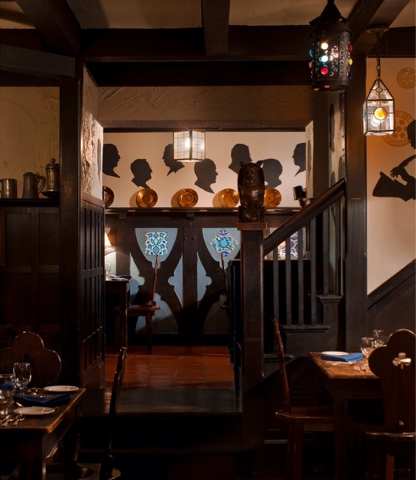
Club members established a Club House in 1790, Obadiah Brown House, where they combined its second and third floors to create a grand exhibition gallery flooded with daylight from the windows in its monitor roof. There the Art Club holds its dramatic presentations, musical evenings, and lectures. On the ground floor the founders preserved the old kitchen and dining room, where they gathered at lunch for Rhode Island jonnycakes - a tradition still observed today. The artists furnished the Club House with tables and chairs of their own design and construction. They decorated the fresh plaster with ornamental friezes and then painted the silhouette profiles of Club members on the walls. They made fantastic wrought iron andirons for the fireplace and lined the shelves with their beer steins. Paneled with the original wooden shutters saved from the old windows, the Club House is renowned for having some of the most comfortable and charming club interiors in Providence. 

Just as the Club has worked to preserve its buildings, it has remained dedicated to the spirit which inspired its beginning. The Providence Art club continues a tradition of sponsoring and supporting the visual arts in Providence and Rhode Island in an atmosphere of good company and pleasant surroundings.

-Robert P. Emlen, 38th President (1991-1993), Providence Art Club

Today, we have just under 650 members, with about 300 artists members who exhibit their work in our galleries and participate in our member classes. Our Club also hosts private events and parties, as well as weddings. Our two galleries, the Dodge House Gallery and the Maxwell Mays & Moîte Gallery, have rotating shows every 3 weeks, and are always free and open to the public. 

For more information, visit: http://providenceartclub.org


Natural Bridge State Resort Park, Kentucky

Come see this natural sandstone arch, it took nature millions of years to make
Just make sure that a picture of it, you take