Wednesday, May 18, 2016

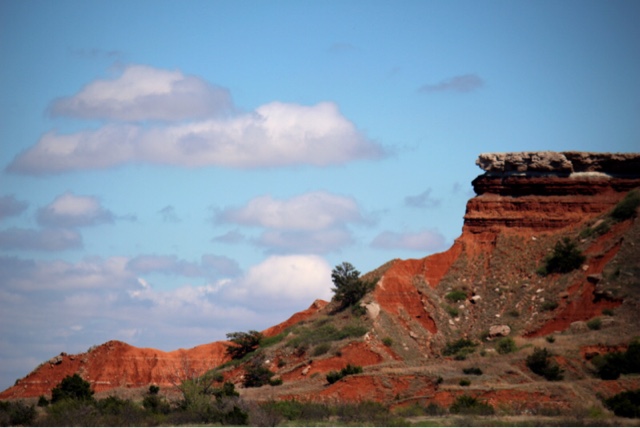
Gloss Mountains, Fairview, Oklahoma

These mountains are oh so fine
They are said to really shine

The Gloss Mountain area was originally an inland ocean.  The white gypsum crystals and rock layers were formed as calcium sulfate saturated the water which was trapped in the mud of the sea floor.  Over time, both shale and gypsum were buried beneath several thousand feet of more recent sediments.  Development of the Rocky Mountains caused the broad uplift of the Western United States.  This uplift raised all of Oklahoma above sea level.  Ongoing erosion began exposing the shale and gypsum layers - now known as the Gloss Mountains!

Is it Glass or Gloss Mountains?  That's the question!  Glass Mountains was first used in 1873 on a map issued by the US General Land Office.  In 1875, a second map labeled this areas as the Gloss Mountains but it was apparently a drafting error.  Locals still refer to them as the Gloss Mountains.

A few outlaws have roamed the land.  Desperados like Dick Yeager took refuge in the rugged country.

The "white rings" of gypsum in this area is very high in purity; therefore, it's used in pharmaceuticals and food products - baking soda, bread, candy, beer.  


Wednesday, May 11, 2016

Bemidji, Minnesota

Come to this town's visitor center, you will find it great
For it has a fireplace built of stones from every state

By Darla Sathre (from The Depot Express newsletter, Fall 2014)

I love rocks. So no matter where I am or what I am doing, rocks can get me sidetracked. The nationally known Fireplace of States located in Bemidji’s Chamber of Commerce Tourist Information Center is made of over 900 rocks from all over the country. It all started in the early 1930s with an idea from Harry E. Roese, district manager of the Federal Reemployment Service, as well as president of the Civic and Commerce Association in Bemidji. His grand idea was of a fireplace containing rocks from every state in the union, from every Canadian province, from all 87 Minnesota counties, and from all the national parks. The building of the fireplace became one the New Deal projects designed to keep people working during the Depression.

A short sidetrack concerning Harry Roese: He was the owner of the classy Shorecrest Resort with the dance pavilion on Birchmont Drive.

He did not work alone. A secretary in Harry’s office, Miss Kathleen Wilson, was directed to write solicitation letters for the rocks. Fifty years later she still marveled at how willing people were to send their rocks to Bemidji, especially considering shipping costs of heavy rocks. As the rocks came tumbling in, each was numbered so an identification key could be compiled.

Mark Morse was the stone mason in charge of building and designing the fireplace. (If I were to go on a sidetrack now I would tell you about the Bemidji State University outdoor fireplace, the Greenwood Cemetery pillars, and Mark’s many other masonry projects in Bemidji).

By the end of 1935, the fireplace was completed as part of the octagonal Bunyan House on the shore of Lake Bemidji. For decades tourists admired the great fireplace and the many rocks.

As a sidetrack, I came across a 1939 newspaper article about Miss Elsie Mae Willsey acquiring some circa 1514 tiles in Puerto Rico, from the home of the Spanish Explorer Ponce de Leon, that she planned to bring back to Bemidji to be added to the fireplace. We are not sure about what happened to these. By the way (a sidetracked way), Elsie was a daughter of the well known Captain Willsey of early Bemidji renown, but that would be a whole ‘nother story.

By the mid-1990s, the building was in poor shape and needed to come down. But the great Fireplace of States was to be saved! It was segmented, shrink wrapped, and moved with a crane into the new Tourist Information Center next to the 1937 statues of Paul Bunyan and his blue ox, Babe. Visitors still love the impressive Fireplace of States. Go see it. The only thing missing is the key. The only rocks that we are certain of the origin are the ones that were engraved by the donors. But it is still worthwhile to check out!

For more information, visit: http://beltramihistory.org/2014/10/02/sidetracked-fireplace-of-states/

Bemidji, the First City on the Mississippi, is a historically charming, progressive northwoods city.  Soon after its birth at Itasca State Park, the world’s fourth longest river- the Mississippi, travels north to Bemidji.  After crossing through Lake Bemidji, it swings south on its 2,552- mile journey to the Gulf of Mexico. 

History, diverse culture, legend and lore mingled with an abundance of bald eagles and waterways, give the Bemidji area its unique character.  400 fishing lakes in a 25-mile radius invite anglers and provide a variety of recreational opportunities all year around. The natural rhythm of changing seasons draw bikers, hikers, skiers and snowmobiling enthusiasts to the area’s State and National Forests.  400 miles of groomed snowmobile trails and 140 kilometers of cross country ski trails wind through the scenic north woods.  Minnesota’s northwoods holds a treasure trove of natural beauty for those seeking peaceful refreshment.    

For half a century, logging was the economic lifeblood of the area.  By way of celebrating the turn-of-the 20th century booming industry, an 18 ft. statue of the legendary lumberjack Paul Bunyan and Babe his Blue Ox were constructed at the waterfront for the 1937 Winter Carnival. This famous duo has posed with visitors for countless memorable photographs ever since – earning Midwest Living magazine’s ‘‘Best in the Midwest” Roadside Attraction Award in 2003.  Paul’s memorabilia, displayed in the adjacent Tourist Information Center, is sure to bring a grin.

 Native American and Scandinavian cultures are woven together into the tapestry of Bemidji’s history.  Several events and galleries showcase the community’s rich and diverse cultural heritage.  A remarkable collection of sculpture and outdoor art throughout the downtown area offers a glimpse into the creativity this beautiful area inspires.  Live performance theater, science and history museums and art galleries dot the downtown shopping and dining district.

Even though Bemidji is a regional retail and educational center, with the amenities of a large city, it still maintains a small-town atmosphere.  The surrounding region abounds with interesting places and things to do.  A few memorable places to visit are; the Headwaters of the Mississippi River at Itasca State Park, the Laurentian Continental Divide, the ‘Lost Forty’ forest of 350 year old trees, historic Camp Rabideau CCC Camp, birding hot spots and the Forestedge Winery.

 Whether you are seeking a traditional vacation, a weekend getaway or want to enjoy your favorite sport, Bemidji is an ideal spot to relax and refresh.

For more information, visit: http://www.visitbemidji.com/


Wednesday, May 4, 2016

Petrified Forest National Park, Arizona

This forest certainly does not lack in natural goods
For in the U.S., these trees are the most extensive petrified woods

The park of course is best known for its Late Triassic petrified logs and other fossils, but also protects 13,000 years of human history, and some of the best examples of native Arizona shortgrass prairie. 

For more information, visit: https://www.nps.gov/pefo/index.htm


Photo credit: NPS


Wednesday, April 27, 2016

Flag House & Star Spangled Banner Museum, Baltimore, Maryland

The home of flag maker Mary Pickersgill is a must see
This National Historic Landmark was built in 1793


STAR-SPANGLED BANNER FLAG HOUSE

Legal Name: The Star-Spangled Banner Flag House Association Inc. 

Built in 1793, the Star-Spangled Banner Flag House was the home and place of business of Mary Pickersgill, maker of the flag that inspired Francis Scott Key’s famous poem that later became our national anthem. Mary and her daughter Caroline moved into the house in 1807, along with Mary’s mother, Rebecca Young, who began the flag-making business in Philadelphia during the Revolutionary War.

In 1927, the house was purchased by the City of Baltimore and the Star-Spangled Banner Flag House Association established a museum inside the historic home. It was established as a National Historic Landmark in 1970.

Today, visitors encounter the interior of the Flag House restored to an 1813 appearance. The house is filled with original early 19th century objects, many of them possessions of the Young-Pickersgill family. Throughout their professionally guided tour, visitors explore aspects of business and daily life in the Flag House by interacting with a variety of objects and the stories of the individuals who lived alongside Mary during the making of the Star-Spangled Banner Flag.

JEAN AND LILLIAN HOFMEISTER MUSEUM BUILDING

In 2003, the Hofmeister Museum Building was opened to provide a space for a welcome desk, gift shop, orientation theater, exhibition galleries, and administrative offices. A magnificent feature of the Hofmeister Museum Building is the two-story Great Flag Window, the same size and design of the original 30 ft. x 42 ft. Star-Spangled Banner. This amazing façade is one of Baltimore’s newest icons.

Located on the first floor of the Hofmeister Museum Building is the permanent exhibition, Family of Flagmakers: The Women Who Created the Star-Spangled Banner. Family of Flagmakers is the first exhibit devoted to the life and career of Mary Pickersgill. The exhibit showcases period and personal family objects, including the original receipt for the Star-Spangled Banner, on public view for the first time in decades. Visitors are treated to interactives and archeological objects that highlight the history of the historic Flag House from the late 18th century until today.

There’s plenty to see and do for our youngest visitors in the Discovery Gallery, also located on the first floor of the Hofmeister Museum Building. Little ones can cook at a replica of the Flag House kitchen, design their own flag, tell a story at the puppet stage, or dress in period clothes.

ORIGINAL MUSEUM BUILDING

Located between the historic house and the Hofmeister Museum Building, this 1950’s structure was vacated in 2003 with the opening of the Hofmeister Museum Building. As part of the Flag House Improvement project the original museum building underwent a full renovation and was renamed the Maryland House Educational Resource Center. When visiting for a field trip children are engaged in a classroom atmosphere to learn about life and childhood in 1813.

ATTENDANCE

In FY15, the Flag House attracted nearly 10,000 visitors. Approximately 55% of these visitors were from Maryland and the remaining 45% came from outside the state, including numerous foreign countries.

School-aged children make up over 66% of the museum’s visitors. Students come from public and private schools throughout the region, as well as, home-school programs. School groups receive a discount on admissions. Through partnerships with private funders, the Flag House provides free admission and school bus reimbursement for Title I schools.

ON-GOING PUBLIC PROGRAMS

School Programs

The Flag House’s school programs meet Maryland State Department of Education standards and indicators for social studies. The museum offers a variety of themed programs and tours, such as Young Patriots, Stars and Stripes, Freedom Tour and Living in 1812. Many of the tours can be supplemented with hands-on learning activities.

Scout Programs

Accommodating troops of all ranks, The Flag House offers these badge-earning programs to both Cub Scouts and Girl Scouts looking to explore patriotism and early American history. Brownies and Girl Scouts can learn the history of the U.S. flag, hike to Ft. McHenry, practice early 19th century manners with a tea party or even discuss the stories of important women who contributed to our history. Cub Scouts can complete badge requirements in special activities covering patriotism, flag etiquette and American history.

Period Cooking

Starting in Fall 2015, the Flag House reinstated the annual period cooking demonstration. In partnership with the historic Riversdale Kitchen Guild and local farms the Flag House prepares food common in the Chesapeake region during the early 19th century. Interpreters and staff welcome visitors into the home to experience domestic life in 1813.

Awards and Signature Events

The Mary Pickersgill Award for Women’s Leadership in Business

Begun in 2012, the Mary Pickersfill Award has become one of the Flag House’s signature events. Each year the award honors a woman who is a leader and a credit to her community much like Mary Pickersgill was in 1813 and exemplifies innovation in her chosen field and has the power to inspire others.

Each year on June 14th the Flag House celebrates Flag Day with a public program. In 2012 the museum hosted the National 9/11 Flag. The 2014 program, #TheFlagICarried was inspired by board member Matthew Eversmann. Mr. Eversmann’s heroic efforts in Somlia in 1993 during the Battle of Mogadishu provided the inspiration for the book and film, Black Hawk Down. Mr. Eversmann carried an American Flag during his deployment and on Flag Day 2014 the Flag House will honor veterans and the flags they have carried with them into battle. The 2015, Flag Day program welcomed local families, donors, and members to a fun filled day of activities and the presentation of the Flag House Scholar Award.

The Flag House Scholarship Award and Essay Contest

Open for submissions to high school seniors, the Flag House Scholarship Award selects a winning essay to be read during the Flag Day program. The winner receives a scholarship of $1,812, generously provided by the Daughters of the War of 1812.

WAR OF 1812 BICENTENNIAL CELEBRATION

The Battle of Baltimore was a decisive victory that renewed the hopes of a demoralized young nation. The Maryland War of 1812 Bicentennial Commission has planned spectacular events and an educational initiative to commemorate Maryland's unique contributions to the defense and heritage of the United States. The Flag House is located on the new, federally designated Star-Spangled Banner Trail (similar to the Freedom Trail in Boston) and has played a major role in the Bicentennial Celebration.

UPDATES AND MILESTONES IN 2015

The Board of Directors completed 80% of their FY15 goals. The Flag House secured funding for new security cameras, realized 115 essay submissions for the Flag House Scholar Award, and awarded the Mary Pickersgill Award to Dr. Carla Hayden, CEO of the Enoch Pratt Library, extended off-site outreach to six sites that provided hands-on youth and adult education, hosted 1,000 individual visitors during the Star-Spangled Spectacular in September, 2014, participated in our fifth year of SuperKids camp through the generous support of Parks and People, and launched a new website in April, 2015. Grants awarded in 2015: American Alliance of Museums Museum Assessment Program for Collections Stewardship, provides up to $6,000 of in-kind services and materials to support small museums. $20,000 restricted donation for flagpole refurbishment from the Children of the American Revolution. Baltimore National Heritage Area Operating Grant that will support marketing materials, tour sponsorship for underserved schools in Baltimore City and County, off-site outreach, and staff development for FY16 – FY17. $6,500 in restricted project funding from the William G. Baker, Jr. Memorial Fund for administrative technology upgrades. $3,500 from the Daughters of 1812 in support of the Flag House Scholar Award and purchase of new collection management software.

 Flag House Quick Stats:

How many years have you been in operation? We have been a museum since 1927, 88 years. HowmanypeopleareonyourBoardofDirectors? 30

How many people visit your site per year? We serve around 10,000 visitors each year and hope to increase that number by assisting additional staff and exhibits.

Who do you serve? In FY15 of our paid visitors, 20% were adults, 60% were students, 5% military and 15% seniors.

Who are your largest funders? Baltimore County, Whiting-Turner Contracting, Middendorf Foundation, Ensign C. Markland Kelly Foundation, Laverna Hahn Charitable Trust, and the Babylon Foundation, William G. Baker, Jr. Memorial Fund, Henry and Ruth Blaustein Rosenberg Foundation, Associated Jewish Charities, Macht Family Foundation. 

For more information, visit: http://www.flaghouse.org/


Wednesday, April 20, 2016

Jesse James Farm and Museum, Kearney, Missouri

This is a cool place to visit either day or night
You can even visit Jesse's original grave site

Jesse James, son of a Baptist minister, was born at the family home in Kearney, Missouri, in 1847. Barely 16, he followed his older brother, Frank, into the Civil War. While Frank was a member of Quantrill’s guerillas, Jesse rode with Bloody Bill Anderson. When the war ended, Jesse returned home and joined other former Confederate guerillas in a life of outlawry.

Jesse’s boldness and flamboyance as a bank and train robber, combined with sensational publicity from newspapers and dime novels, soon made his a household name.

A tour through the restored home will take visitors back to where the legend began.  Before walking the trail to the farmhouse, a twenty minute movie recaps the history of Frank and Jesse James and exploits of the outlaws.  The museum displays the world’s largest collection of James family artifacts.  Jesse’s boots and Frank’s surrender letter tend to captivate visitors.  Guests then follow the paved winding trail to the farmhouse and walk along the creek where, as young boys, Frank and Jesse spent much of their time playing.  In the yard of the family home is Jesse’s original burial site, the place where his mother once sold souvenir rocks from his grave for twenty five cents. 

Upon completion of the tour guests will want to browse the museum's gift shop.  A wide variety of books relating to the period are available as well as t-shirts, mugs, and many other souvenir keepsakes. 

Jesse James' Birthplace is owned and operated by the Department of Clay County Historic Sites. 

For more information, visit: http://jessejamesmuseum.org/


Wednesday, April 13, 2016

Greenbank Mills & Philips Farm, Wilmington, Delaware

Learning about Delaware in the Early Republic feels so right 
At this 300 year old gristmill, textile mill, and farm-site

Greenbank Mills & Philips Farm is a living history museum with tours and programs focusing on a variety of aspects of the Early Republic (1790-1830): the gristmill, the textile factory, and daily life at the 1794 Philips House and 19th century farm with heritage livestock. Greenbank Is ...... an oasis in a busy shopping corridor, a lush green space filled with history and beauty and the tranquility of years gone by. It is a creative space where you can sink your fingers into soft growing wool, into fertile soil, or onto wood and stone worn down after hundreds of years. There is no better place, no easier place, to reach back into a simpler time and into your own soul.

For more information, visit: www.greenbankmill.com


Sunday, April 3, 2016

Natural Bridge of Alabama, Natural Bridge, Alabama

To everyone, let this fact be known
This rock bridge, the longest natural bridge east of the Rockies, is made of sandstone